
This Is More Than Just One Guide
11 courses and 27 free guides on AI automation for business — and beyond.

A Deep AI Agent: An Expert Built From Books
A regular AI knows about everything — but only on the surface. Ask it about marketing and you'll get the 'internet average.' We went another way: we took books by top experts, pulled out their core principles, and packed them into a knowledge base. Now our agent doesn't answer 'like everyone' — it answers like an expert who has read the right books, and shows where every piece of advice comes from. This guide breaks down how it works in plain words, and why it's cheaper than it sounds.
What's Inside
Free · 6 min readA Regular AI Knows Everything. And Nothing.
The model was trained on the whole internet at once: articles, forums, comments. So when you ask a real question, it answers with an average. Here are the three walls you hit.
'Internet average' answers
Ask about ads — you get a summary of what everyone writes. No depth, no system, no backing from strong sources.
It doesn't know your case
The AI has no idea about your niche, your product, your constraints. You re-explain everything each time — and still get generic words.
Hard to know what to trust
The advice sounds confident, but where did it come from? A study or a random post? You can't check — there's no source.
From a Bookshelf to a Smart Agent: 4 Steps
Every step comes with a concrete algorithm: exactly what to do — and how it's wired in our own STORIUS.
You create an agent for one task
An agent is an AI with a role and an instruction. The instruction is a plain text file, but half the result depends on it: the agent must know who it is, where its knowledge lives, and by what rules to read it. Written in words, without a single line of code.
The Algorithm
- 1Define the role in one sentence: 'You are a short-video strategist. Every recommendation rests on the knowledge base.'
- 2Forbid making things up: if the base has no answer, the agent says so directly instead of improvising.
- 3Set the answer format: breakdown → recommendations → principle references. That makes every tip verifiable.
How We Do It
The STORIUS instruction has this as a standalone rule: 'Without a note reference, a recommendation carries no weight.' That's what separates an expert from a talker.
You give it a library
A knowledge base is only as good as its books. Don't grab everything: 2–3 strong books beat ten random ones. What matters is that the authors approach the topic from different angles — the overlaps between them show which principles you can trust.
The Algorithm
- 1Pick 2–3 books by practitioners with proven results, not retellings of other people's theories.
- 2Choose authors with different backgrounds: when their conclusions overlap, that's a sign of a durable principle.
- 3Load the full book, not a summary: the AI will work through it chapter by chapter, missing nothing.
How We Do It
We took Brendan Kane's One Million Followers and Hook Point, plus Derral Eves' The YouTube Formula — three different takes on one question: why content takes off.

The best ideas get pulled out of the books
The key stage. The AI walks through the book chapter by chapter and writes out candidates — one idea per note. Then a hard filter: every idea gets scored on a 10-point scale, and everything below 5 is cut. What remains isn't a summary — it's a concentrate of applicable ideas.
The Algorithm
- 1Score every idea with three questions: is it specific, does it apply to your task, is there evidence behind it.
- 2One note — one idea. Add a 'how to apply to my task' block to each — that's the working layer of the base.
- 3Link the notes [[to each other]] and keep a rejection log: you can see what was dropped and why.
How We Do It
In our case, ~750 candidates became 406 notes — each with a score, a type, and an 'Apply to Reels' block. Every rejection is logged: an audit trail of decisions.
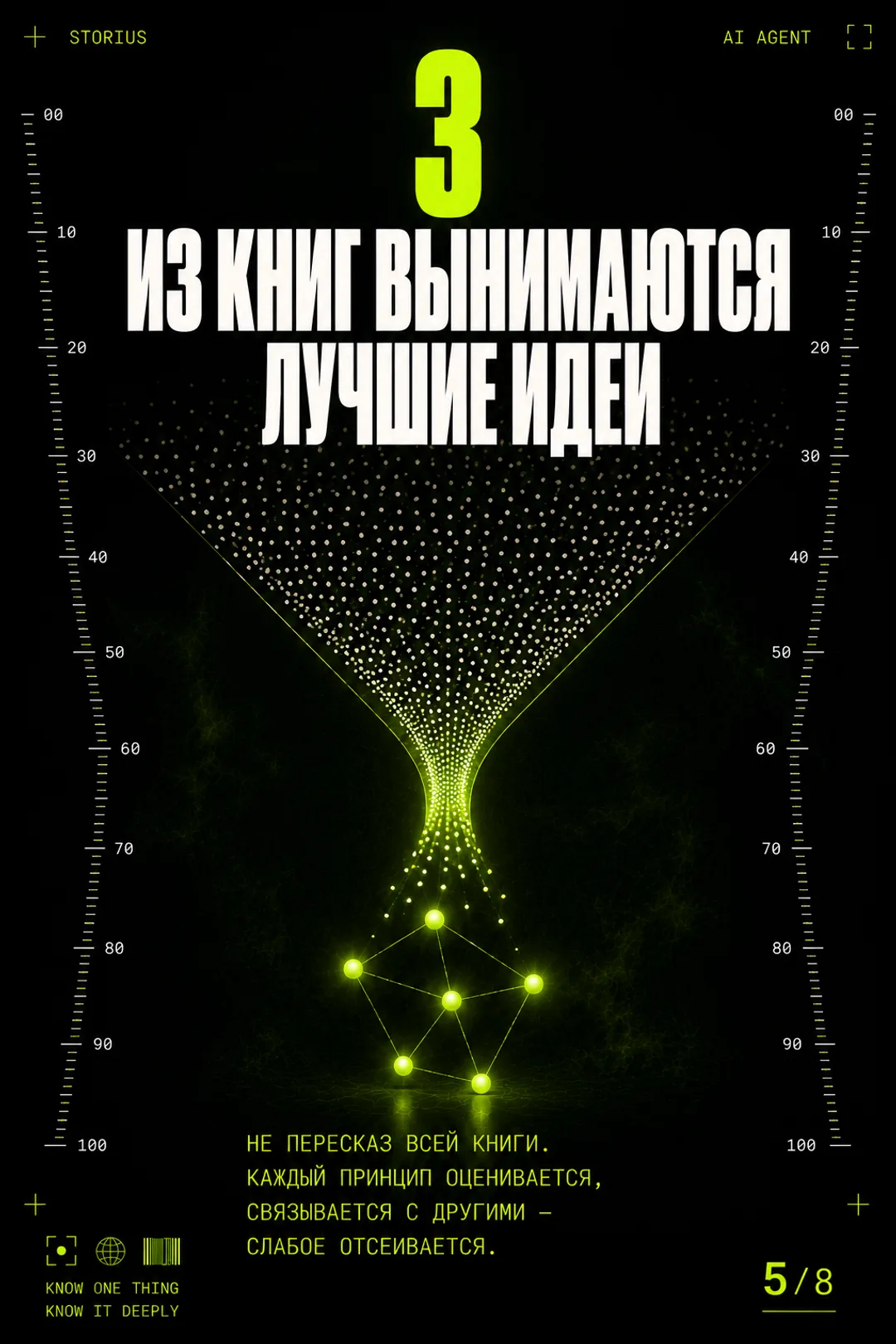
For your question, the agent takes only what's needed
The base is ready — now the reading order decides everything. The agent doesn't re-read the books: it follows the route 'map → hub → notes.' First the index file, then the topic hub that matches the question, and from the hub — only the highest-scored notes.
The Algorithm
- 1Write the route into the instruction: first the base index, then the topic hub, then the specific notes.
- 2When options pile up, prioritize 9–10 point notes; the weak ones the agent never even opens.
- 3A principle shows up in two or three books? Bet on it: cross-references are a signal of durability.
How We Do It
STORIUS runs 11 hubs: 'hook,' 'retention,' 'sharing'… A question about headlines opens one hub and 5–10 notes — dozens of times fewer tokens than three full books.

Why the Agent Doesn't Eat Your Budget
AI models charge for the amount of text they read — tokens. If the agent re-read three books for every question, it would cost a fortune. The reading algorithm solves this.
A map of the base
The entry point is a single index file. The agent reads it first and learns where everything lives — without opening the notes themselves.
Topic hubs
Notes are grouped into topic hubs: 'attention,' 'retention,' 'sales.' A question about headlines? The agent opens one hub, not the whole base.
Priority by score
Every note has a score. When there are too many options, the agent reads the 9–10 point principles first and doesn't spend tokens on the minor ones.
Bottom line: instead of three full books, the agent reads the index, one hub, and a few notes — dozens of times less text. And the answers only get deeper.
STORIUS — Our Viral Content Agent
This isn't theory — an agent like this works for us every day. We parsed three books about viral content, scored the principles on a 10-point scale, and linked them into a knowledge base in Obsidian. Now every Reels script goes through STORIUS: it checks the hook, retention, and call to action — and backs every edit with a specific principle from a book.
bestselling books in the knowledge base
selected principle notes
weak candidates cut (below 5/10)
topic hubs for navigation
Every answer is backed by a source. That's the difference between 'I think' and 'the book says.'

What It Looks Like for Us — Live
No renders, no mockups — real screenshots from our working hub. Follow along in order, from the agent team to a finished result with book references.
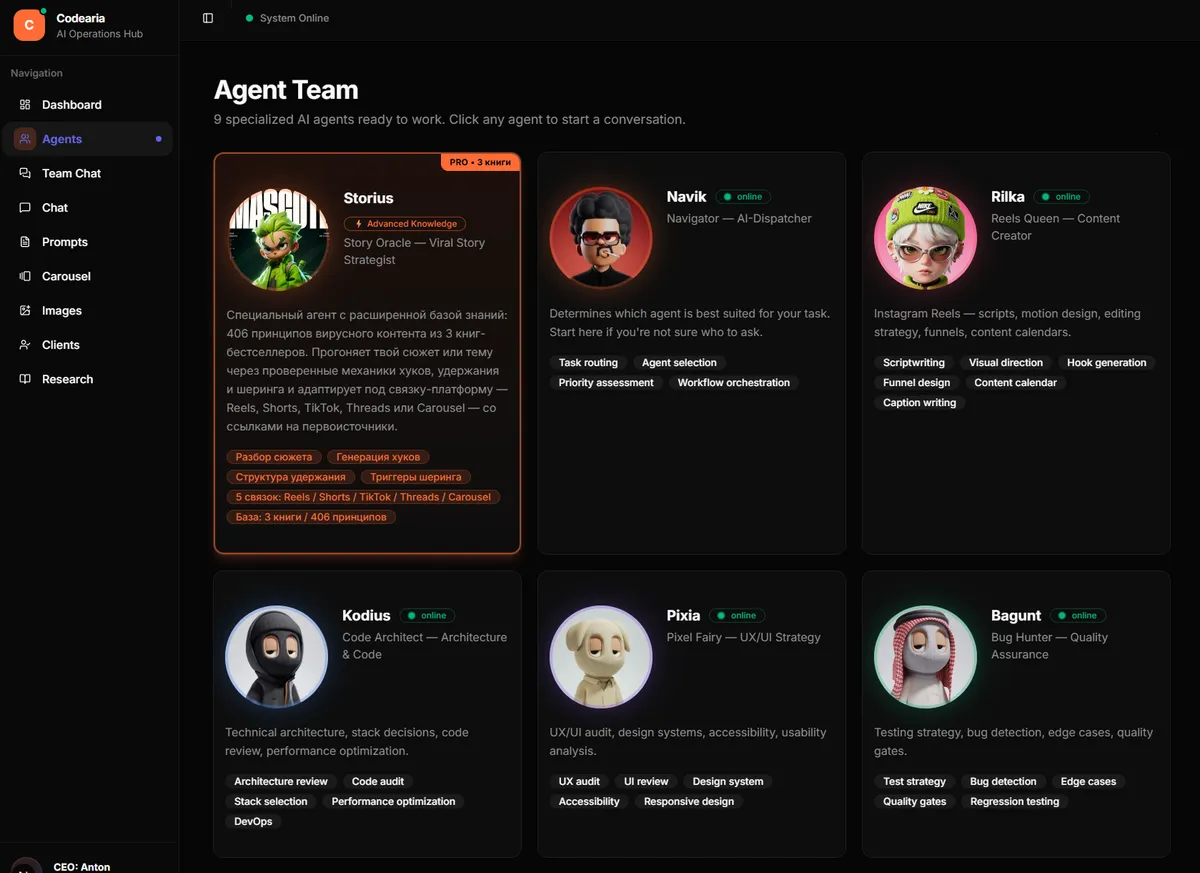
The agent team
Our hub runs a team of AI agents, each with its own role. STORIUS carries the PRO badge: an extended knowledge base built from 3 books.
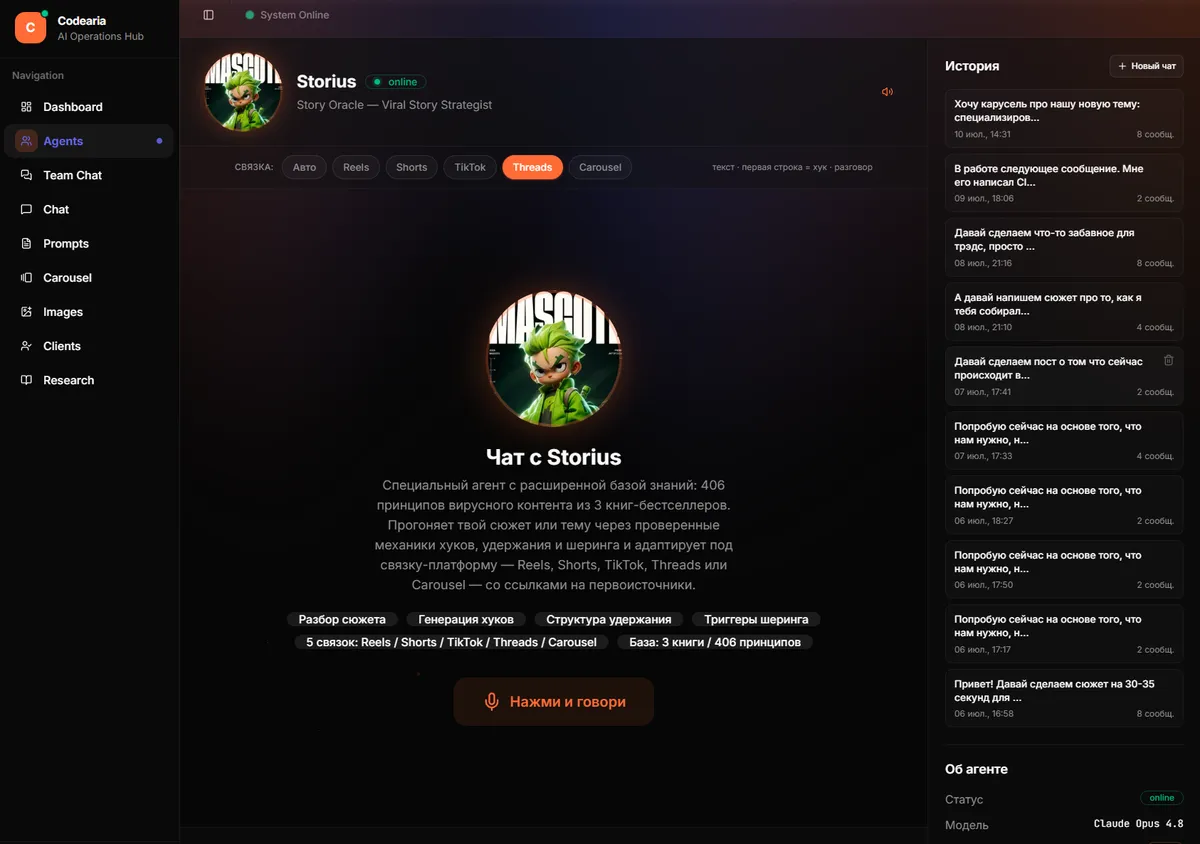
The STORIUS profile
Opening the agent: platform presets (Reels, Shorts, TikTok, Threads), chat history, and voice input.
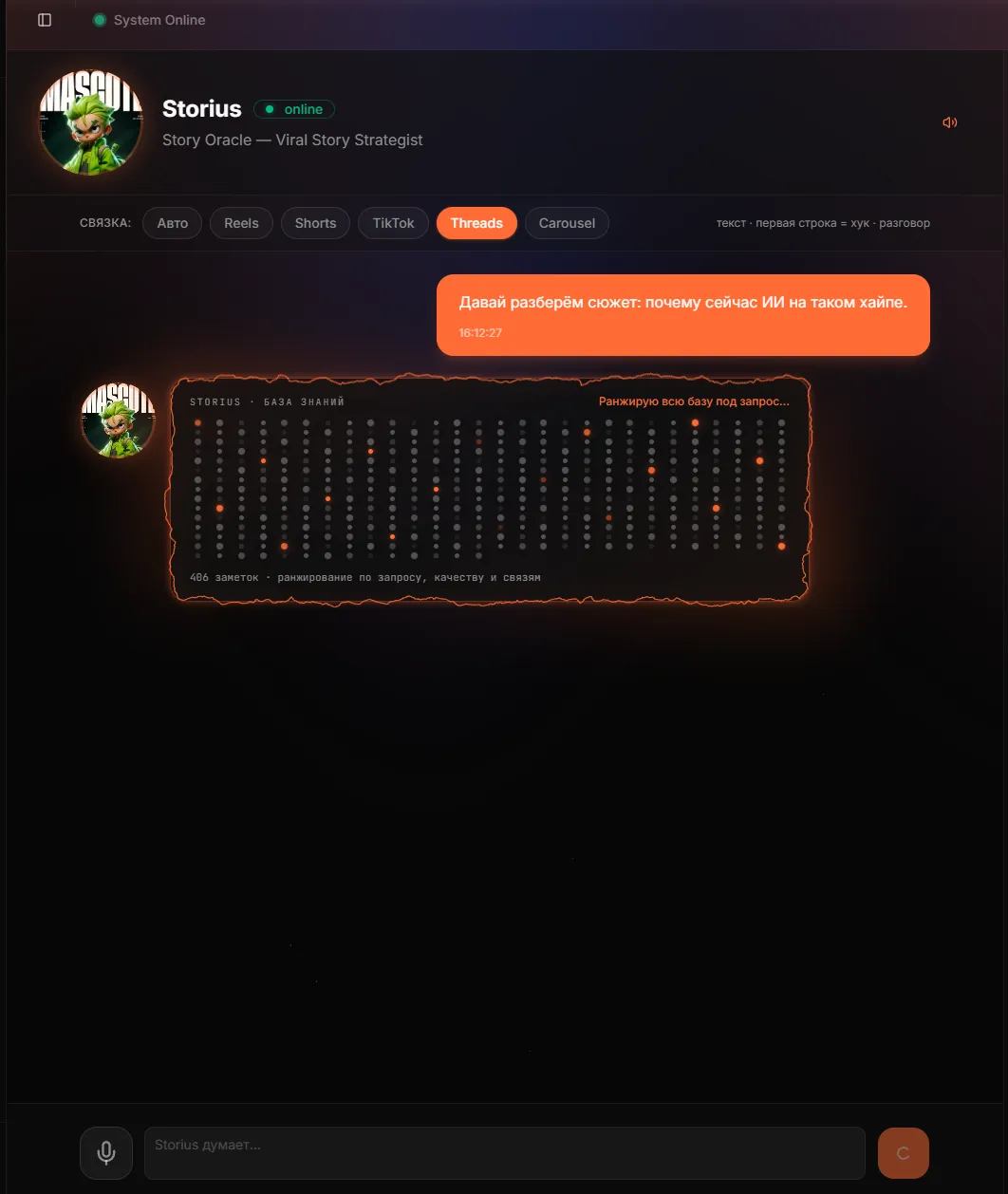
We ask a normal question
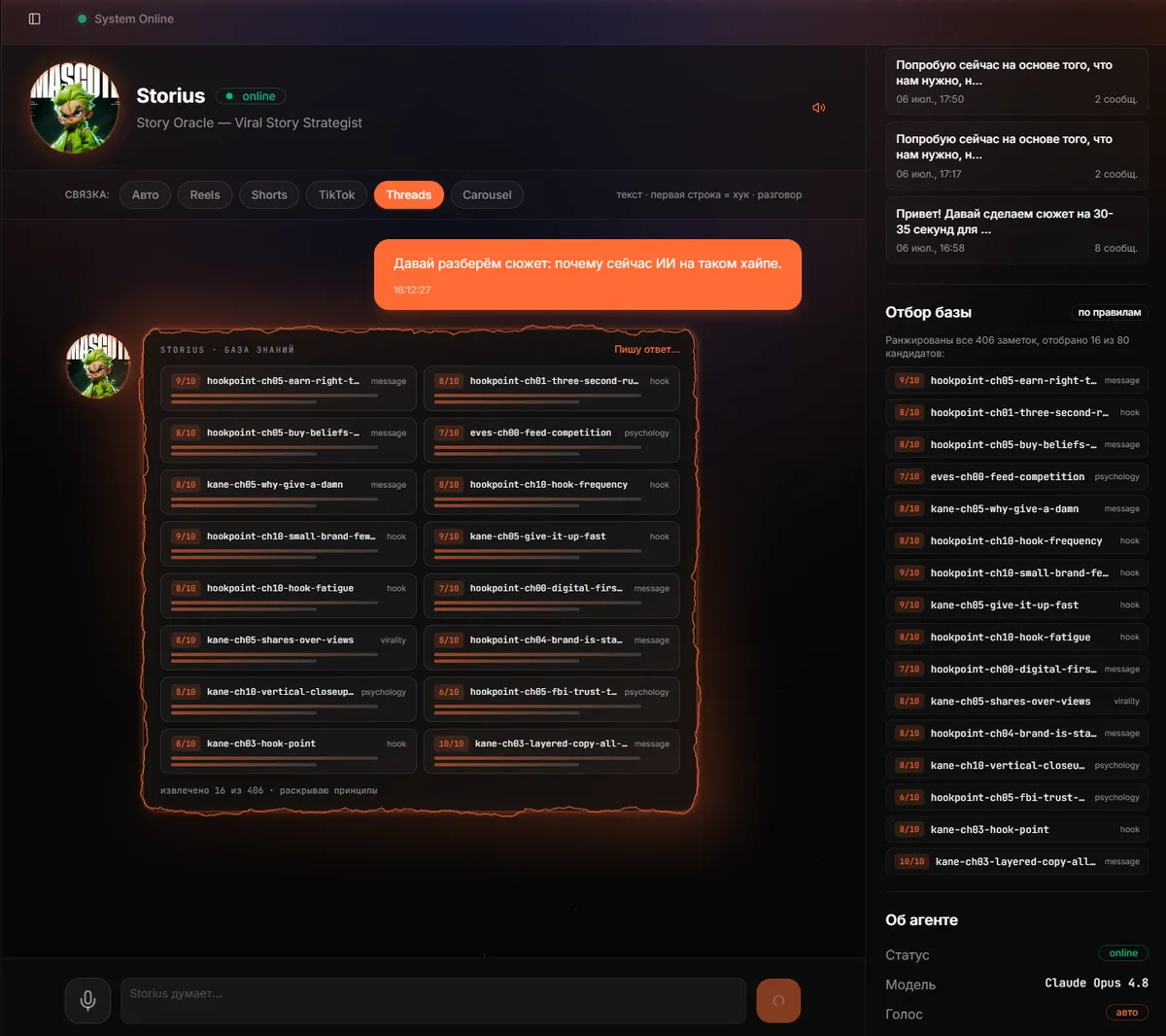
Plain human language: 'Let's break down a story idea.' The agent immediately starts ranking all 406 notes against the request.
The algorithm picks the principles
16 notes selected out of 80 candidates — each with a visible score and type. Only the relevant ones get read: that's the token savings.
The finished result
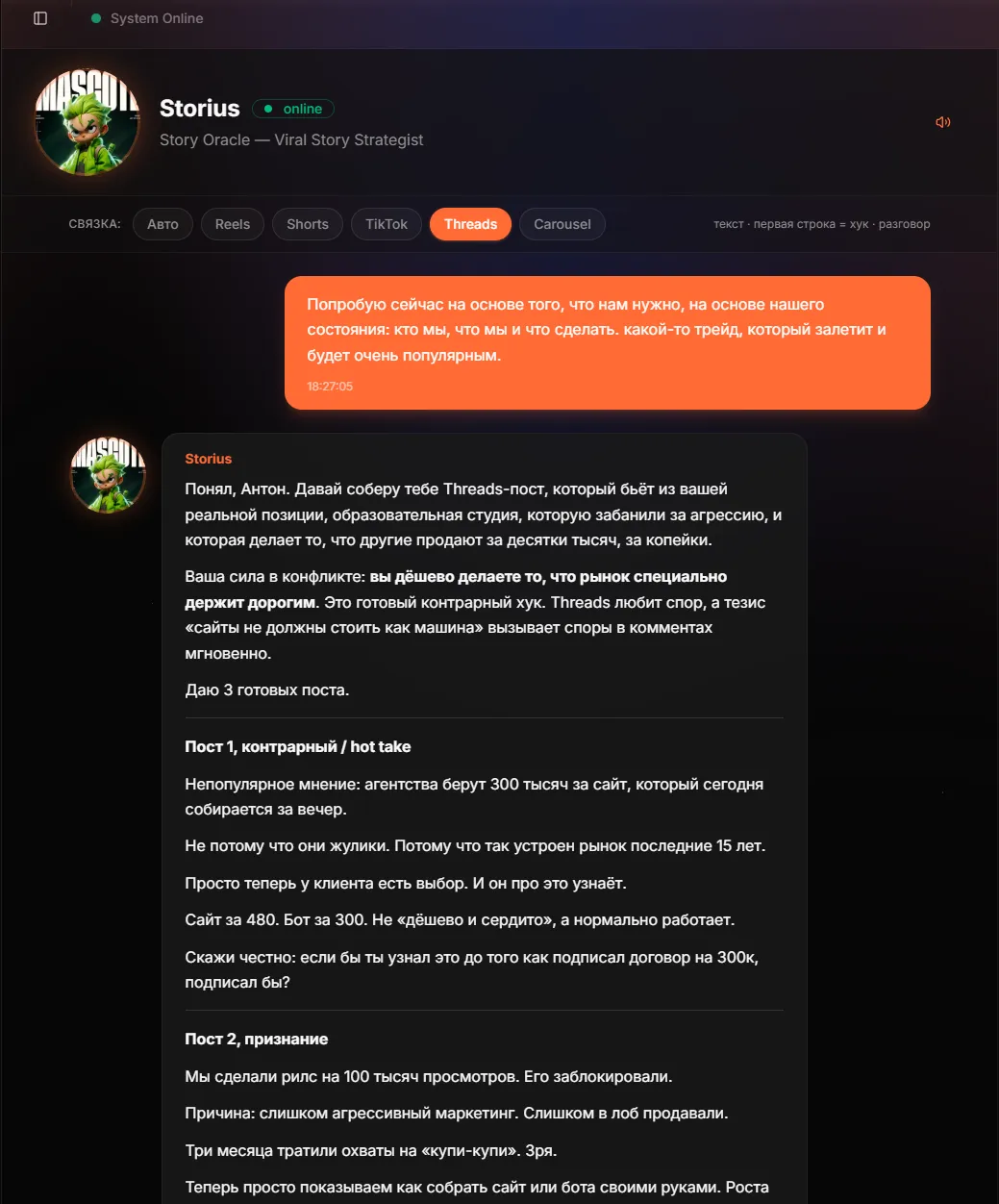
The agent delivers three ready-to-publish posts built for our real situation — not generic advice.
Every tip has a reference
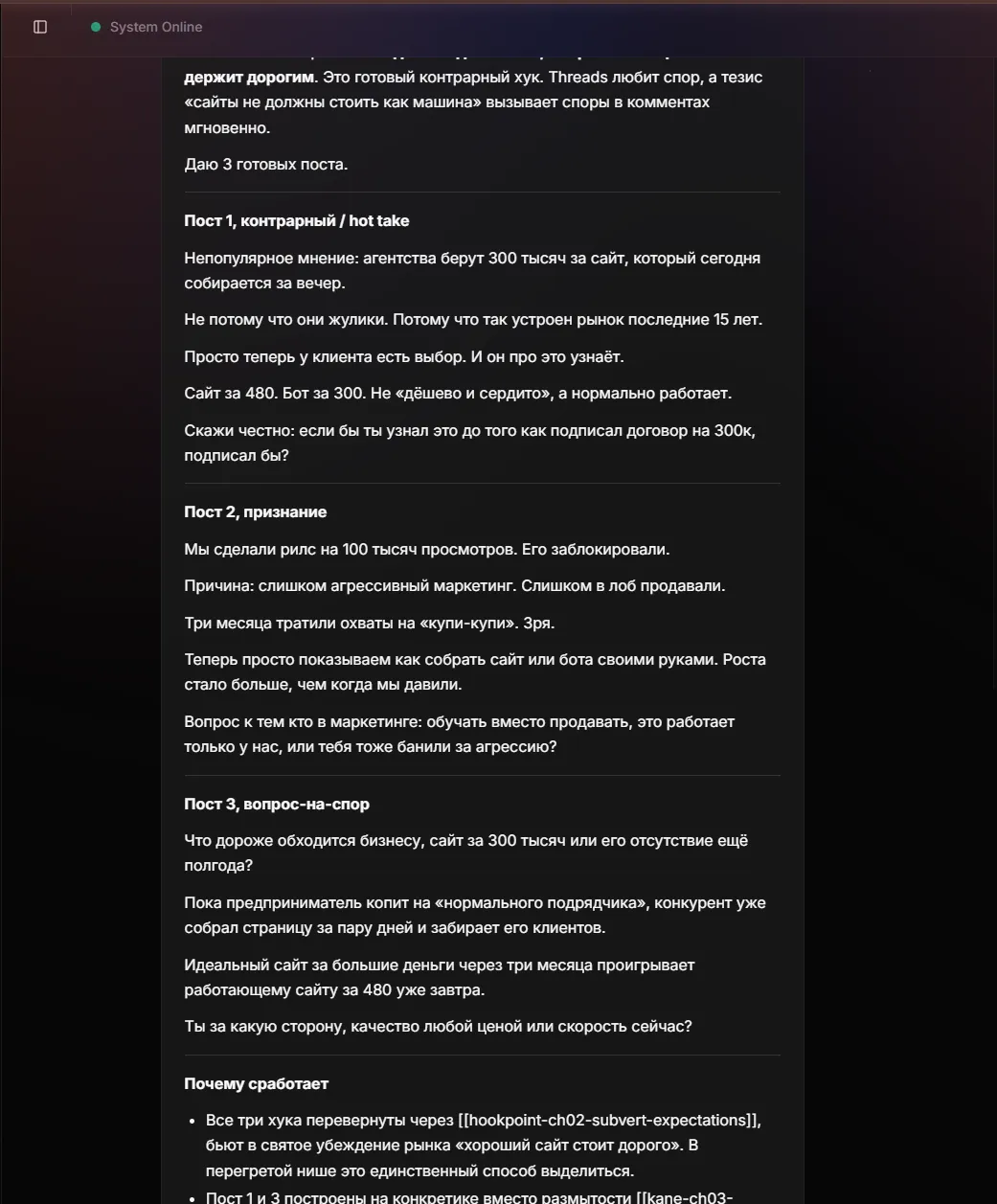
The 'Why it works' block: every decision rests on a specific principle from a book — shown as a [[reference]].
A testing plan
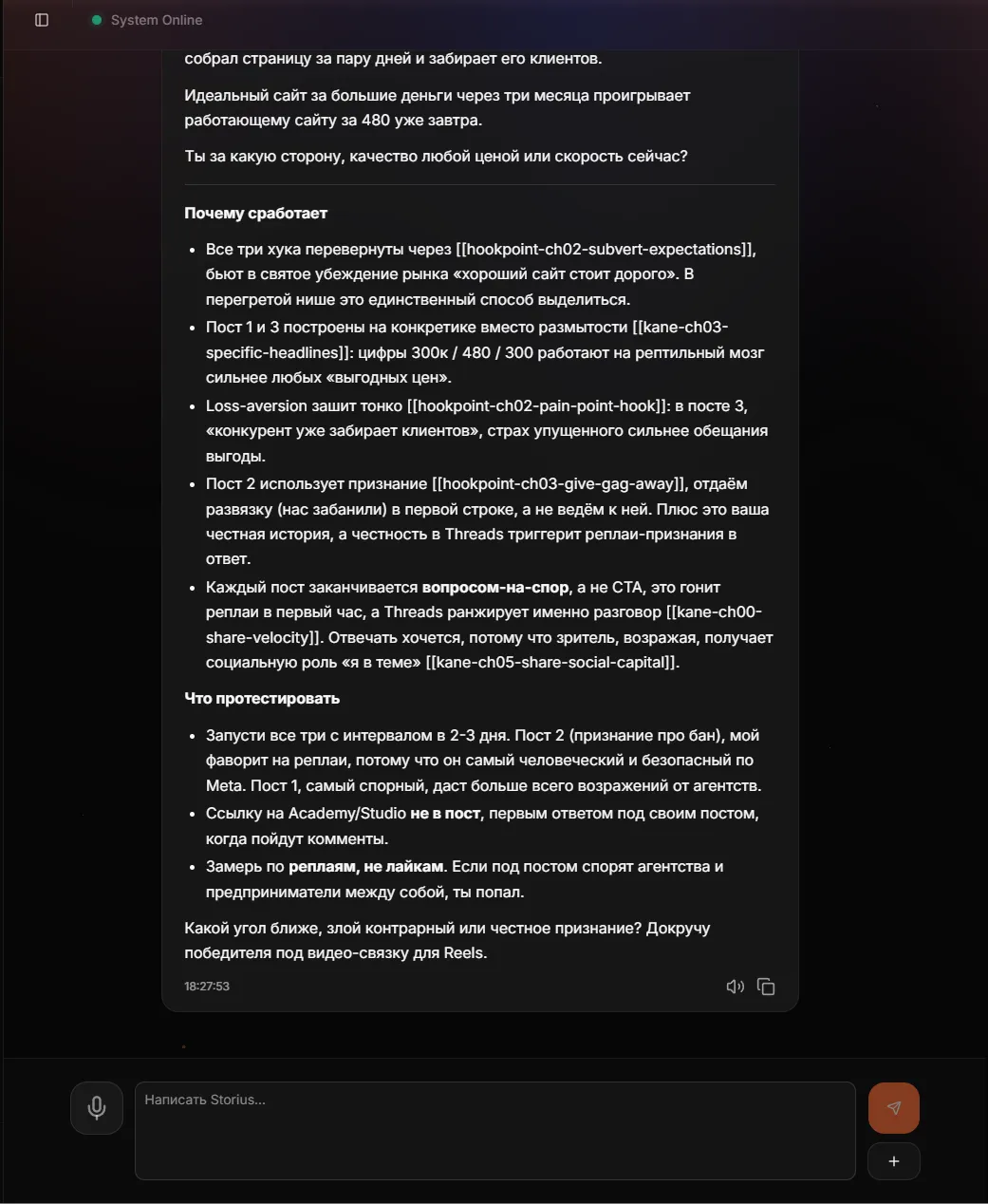
At the end — what to launch and how to measure it. The answer ends with action, not musings.
Scroll sideways — all 7 steps in order
Why Obsidian
Obsidian is a free note-taking app. A knowledge base in it is just plain text files on your computer — which is perfect for an agent.
Plain files
Every note is a regular text file. The AI reads them directly — no databases, no complex setup. And it all stays with you, not in someone else's cloud.
Links between ideas
Notes connect with [[links like this]] — like Wikipedia pages. The agent follows the links from idea to idea and finds related principles.
You see the whole picture
Obsidian draws a graph: which ideas connect and where the central nodes are. If one principle shows up in all three books — it clearly deserves trust.
Course: AI Team Assistants
The guide gives you the concept. The course gives you the practice: how to create agents for your own tasks, feed them knowledge, and wire them into your workflow. No coding experience needed.
What Changes
You stop getting 'internet average' advice.
Your agent answers from a base you trust: every piece of advice rests on a principle from a book you chose yourself. The knowledge compounds: add a new book — the agent gets smarter. And it works for any topic: marketing, negotiation, law, investing. Build the base once — and you have an expert available 24/7.
The Path to Your Own Deep Agent
In broad strokes — so the route is clear. The details of every step are covered in the courses.
01.Pick a topic and books
Decide what your agent should be an expert in, and pick 2–3 strong books on the topic. The quality of the base = the quality of the answers.
The courses walk through every step hands-on: from install to a finished agent wired into your work.
This Already Works Today
STORIUS was built exactly this way, and every day it runs our Reels scripts through 406 principles from books. No magic: books, notes, links, and a clear instruction for the agent. Anyone can build one — on any topic.
Build an Agent That Knows Your Topic
The guide gave you the map. The courses give you the full route: building agents, knowledge bases, automation — with practice on real tasks. Lifetime access, every future course included.
Comments