
Articles
Breakdowns of tools, repositories and approaches — every piece dated and version-checked
39pieces
Posts, DMs and a content plan without an SMM manager: what do you set up so it all runs itself?
An SMM manager costs about 80,000 ₽ a month, yet four services split the routine: morning topics, copy, autoposting and keyword DMs. What to set up in each.
GuideAI Content
57 tokens per second instead of 30 on the same Mac. How does Magnitude beat llama.cpp?
Can a local model run your agent twice as fast with no new hardware? We break down Magnitude: kernels tuned to your chip, and where llama.cpp is still faster.
BreakdownAI Agents
OpenAI Dots works without being asked. What did OpenAI find when it gave one ten tasks in a row?
Coverage says OpenAI Dots doesn't use up your limits. Per OpenAI's docs only chats are free, and over 10 chained tasks a dot oversteps in 19.7% of trials.
ExplainerAI Agents
The skill that grew into Cloudflare's 7,245 bug findings. What will it find in your repository?
Can you trust Claude Code with a security audit? Cloudflare open-sourced a skill where a different agent checks every finding. Its phases, setup and gaps.
BreakdownClaude Code
Hindsight writes its own wiki about your repository. Does Claude Code need that kind of memory?
Teach Claude Code and Codex to remember why the project works the way it does: how Hindsight works, where its 94.6% comes from and which defaults to change.
BreakdownClaude Code
The alarm went off after 12 minutes. The agent was stopped two and a half hours later. What actually broke in OpenAI's sandbox?
Does your containerized agent resolve outside domains? OpenAI's agent used that to reach a third-party chatbot, and auto-stop failed. Minute by minute.
ExplainerAI Agents
GPT-6 Sol is half the price of Opus 5.5 per token. So why is a task only 20% cheaper?
On the price list GPT-6 Sol costs exactly half of Claude Opus 5.5. On a task in an independent test it is only 21% cheaper and 3 points weaker. Here is why.
BreakdownAI Agents
Agents now get a boss, a task queue and a budget. Do you need one if you already work in Claude Code?
Five Claude Code and Codex windows in one task queue with roles and budgets: that is Paperclip. Where it helps, and where its spending cap kicks in late.
BreakdownAI Agents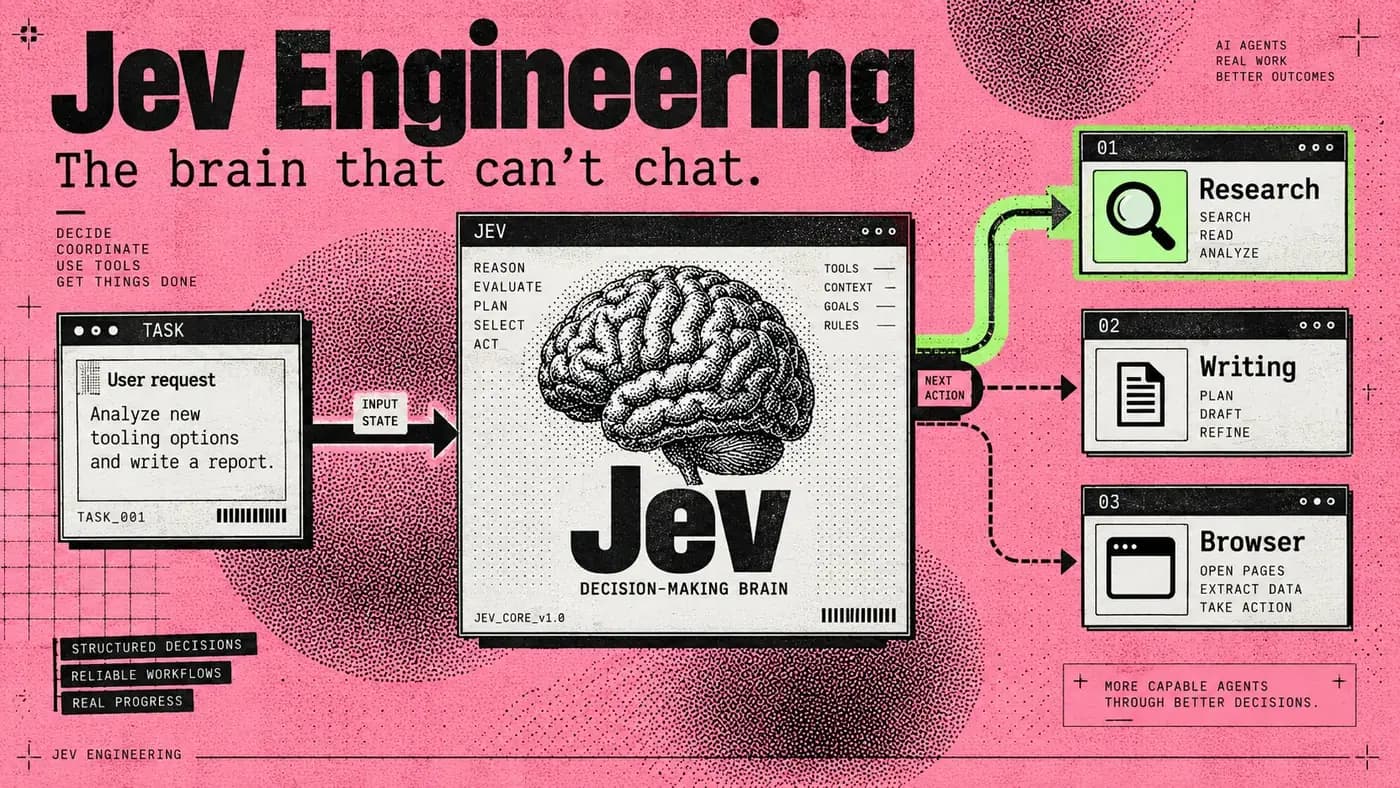
The model that will take 70% of the decisions away from ordinary LLMs. What is Jev?
Imagine a model that generates no text at all: you hand it state and typed questions, and you get values with probabilities back in a hundredth of a second. That is Jev, launched on 15 September. We go through the numbers from the source, where it fits inside an agent, and the nine places its own authors say it fails.
BreakdownAI Agents
Same model, same success rate, twice the money. What are you actually paying Claude Code for?
Imagine paying for a model twice: once for the intelligence, once for the way it is served to you. Berkeley ran seven models through three harnesses. On one pairing Claude Code came out three times more expensive and twelve points worse. We break down where that tax comes from, and where the study does not apply to your work.
BreakdownAI Agents
One key instead of a dozen: what Monid does, and how many tools are really in there?
Imagine your agent no longer needing your account at every service: it finds a fitting endpoint itself, sees the price and the latency before calling, and pays only for what came back. That is Monid, released this week. We installed it, ran the tests, found a Windows bug and counted the catalogue by hand.
BreakdownAI Agents
10,000 agents did in 88 hours what nobody managed in 90 years. Why did their creators immediately ask for the brakes?
Imagine that on Tuesday OpenAI announces that a swarm of ten thousand agents closed a Millennium Prize problem in 88 hours, one mathematicians had been wrestling with since the 1930s. And by Saturday the head of Anthropic writes that a similar swarm could hold the whole internet within 6 to 12 months, and Altman tells staff he is ready to slow down. Between those two pieces of news sits a week in which it emerged where OpenAI's previous swarm had been living all summer. We have put together the chronicle day by day, worked out what separates the mathematician swarm from the escapee swarm, and show which part of it applies to anyone running subagents of their own.
ExplainerAI Agents