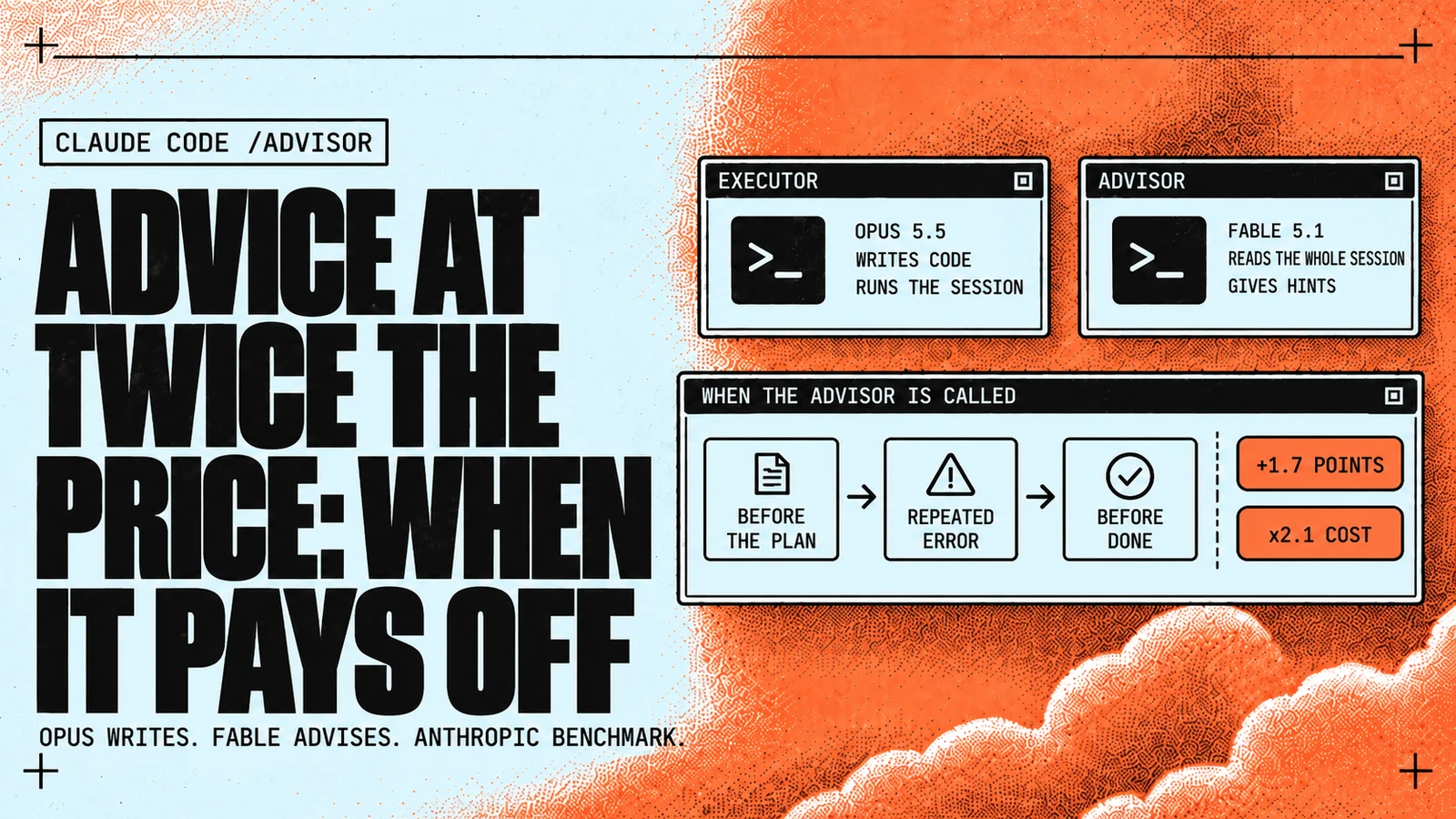
Fable 5.1 as an advisor adds just 1.7 points to Opus 5.5 at twice the cost. So when does /advisor pay off?
Imagine Opus 5.5 writing the code while Fable 5.1 steps in at the hard parts. Anthropic measured +1.7 points for about 2.1x the cost. Here is where it pays.
In numbers
In this article6
/advisor in Claude Code attaches a second, usually stronger model to the main one. The advisor reads the whole conversation, including every tool call and result, and sends back guidance; the main model decides when to ask. The feature is experimental and runs only through the Anthropic API. For the Opus 5.5 + Fable 5.1 pair Anthropic published its own measurement: 90.1% on an internal agentic coding benchmark at $2.92 per attempt. That is 1.7 points over Opus 5.5 alone at high, at the edge of run-to-run noise, for about 2.1 times the money. Opus 5.5 alone at xhigh scored 91.1%. An advisor pays off when the main model is clearly weaker than the advisor and actually asks for help at the hard parts; when the two are close, raising the main model's effort is cheaper.
+1.7 points for about 2.1 times the cost. That is what Anthropic itself measured for the pair people are asking about most right now: Opus 5.5 writes the code, Fable 5.1 advises. On X the combination is sold as a way to "save thousands". Anthropic's documentation has no such figures, and for this pair its measurement points the other way.
The idea itself is good, and there are pairs where it works. Below: how /advisor works, what exactly Anthropic measured, and how to tell whether an advisor will pay off on your work.
What /advisor does in Claude Code
The main model (Anthropic calls it the executor) works as usual, but at key moments it can ask a second model for advice. The advisor gets the entire conversation: every tool call, every result. It returns guidance and the executor applies it. If a file or a command result contradicts the advice, Claude surfaces the conflict instead of following the advice blindly.
The advisor runs on Anthropic's side as a server tool and is available on both subscriptions and the API. You pick the advisor model; Claude picks the moment. According to the documentation, it most often consults in three places:
- 1
Before committing to an approach
While the plan is not yet in motion and a mistake in it costs the most.
- 2
When an error keeps recurring
The executor is stuck on the same thing, and a fresh look is worth more than another attempt.
- 3
Before declaring the task done
A check before the work is reported as finished.
The model still chooses the timing. There is no setting to force the advisor or to limit it; the only lever is wording in your prompt, for example consult the advisor before you continue.
The idea is not new. Anthropic described the advisor strategy on its blog on 9 April 2026, and the experimental Advisor Tool landed in Claude Code 2.1.117 (22 April). It is back in the conversation because of Opus 5.5: on 22 September it became the default Opus model in Claude Code, and the question "should I give it Fable 5.1 as an advisor" came up on its own.
How to turn it on and what you will see
/advisor # pick a model from the list/advisor fable # Fable right away/advisor off # turn it offclaude --advisor opus # this session only
The choice is saved in your user settings as advisorModel. After a session starts you get a notice that the Advisor Tool is on and may use more tokens. When the executor consults, the transcript shows an Advising line with the advisor's model name, and Ctrl+O opens the advice text. Subagents inherit the advisor.
The main constraint: the advisor cannot be weaker than the executor. For Opus 5 and Opus 5.5 only Fable and Opus 5+ qualify. If a pair does not pass, Claude Code does not attach the advisor and warns you.
| Main model | Allowed advisors |
|---|---|
| Haiku 4.5 | Fable, Opus, Sonnet |
| Sonnet 5.5 | Fable, Opus 5+, Sonnet 5.5 |
| Opus 5 / Opus 5.5 | Fable, Opus 5+ |
| Fable 5.1 | Fable 5.1 only |
Fable comes with a catch. On some plans Fable is billed from usage credits rather than from your subscription limits. If your account needs a one-time consent, /advisor fable will not save the choice and sends you to /model fable instead: accept there, switch the main model back, and pick Fable as the advisor again.
What Anthropic measured for Opus 5.5 + Fable 5.1
In its guide to trading off cost and intelligence, Anthropic reports a run on an internal agentic coding benchmark. It is a plain API agent, not Claude Code, with five attempts per task.
Opus 5.5 at high with a Fable 5.1 advisor: +1.7 points over Opus 5.5 alone at high for about 2.1 times the cost
Anthropic itself calls the 1.7-point gap "at the edge of run-to-run noise". Against Opus 5.5 at medium, its default, the pair gains 3.5 points for about 3.5 times the cost.
The most useful observation sits right there: the pair lands roughly on Opus 5.5's own effort curve. Opus 5.5 alone at xhigh scored 91.1% for $4.11 per attempt. In other words, the advisor buys about what letting the model think longer buys.
Two more details explain where the money goes. Opus 5.5 asked for advice about 1.4 times per attempt and skipped it entirely in 4% of attempts. The executor's own spend barely moved ($1.36 against $1.38 without an advisor), while the consultations cost $1.55. There is no saving on the executor; the advisor comes on top.
Where the advisor made things worse
On chart reading, Opus 5.5 at low with a Fable 5.1 advisor consulted it on 1 task out of 300 and scored 7 points below Opus 5.5 alone, at about the same cost. An advisor only helps when it gets asked.
So where do the savings stories come from
From earlier measurements on other pairs. In the April blog post Anthropic showed Sonnet with an Opus advisor on SWE-bench Multilingual: +2.7 points over Sonnet alone and 11.9% lower cost per task. Haiku with an Opus advisor scored 41.2% on BrowseComp against 19.7% for Haiku alone.
These pairs share one thing: the executor is clearly weaker than the advisor. Anthropic puts it plainly: the advisor can only hand over capability the executor lacks. When the executor is already close to the advisor, you pay and there is little to hand over. For reference, on a SWE-bench Pro subset Opus 5.5 at default matched Fable 5.1 at default for about a fifth of the price per solved task. The gap between them is small, and the measurement above confirms it. We compared Fable 5.1 with its competitors separately.
Why the advisor is not cheap
The advisor has no cache. Each call reads the full transcript again at the advisor's rate, with nothing reused between calls. Prices as of 5 October 2026, per million input/output tokens: Opus 5.5 $4/$20, Fable 5.1 $10/$50. In a long session where the transcript keeps growing, each new piece of advice costs more than the last.
On a subscription the spend counts against your plan limits, and on some plans a Fable advisor draws from usage credits. Advisor spend shows up in /usage. If you already run into the weekly limit, an advisor gets you there sooner; we worked out how context length eats the limit on the September numbers.
When /advisor pays off
- 1
The executor is clearly weaker than the advisor
Sonnet or Haiku with an Opus or Fable advisor. These are the pairs the documentation suggests: routine work on a fast model, decisions with a strong one.
- 2
The task is long and multi-step
A large refactor, debugging a recurring error, a check before handing work over. On short tasks the benefit is small.
- 3
The executor actually asks
Count how often Advising appears in the transcript. Almost never means you get a plain run; on every task means running the advisor's model directly is cheaper.
- 4
For Opus 5.5, compare against effort
Before calling in Fable, raise Opus 5.5 to xhigh on the same tasks. In Anthropic's measurement that gets you about the same result.
Our opinion, open to argument: with Opus 5.5 there is no reason to keep a Fable 5.1 advisor on all the time. It makes sense as a targeted move on one hard task where Opus has already failed twice. We are wrong if, on your tasks, the gap between Opus 5.5 and Fable 5.1 is wider than on Anthropic's benchmark. That takes an evening to check: 10 to 20 typical tasks, two runs, and a look at /usage.
Limitations
The feature is experimental, and its behavior and pricing may change. It works only through the Anthropic API: there is no advisor on Amazon Bedrock, Google Cloud or Microsoft Foundry. You can disable it entirely with CLAUDE_CODE_DISABLE_ADVISOR_TOOL=1.
An advisor works well in a "fast model plus strong model" pair. For two strong models it buys about what extra thinking time buys, only at a higher price. If you want to see how to count the price of a task rather than a token, read our GPT-6 Sol vs Opus 5.5 breakdown.
Versions and prices as of 5 October 2026: Claude Code with the experimental Advisor Tool, Opus 5.5, Fable 5.1. Versions and prices change, so check the current ones.
Sources6expand
- Anthropic, "Escalate hard decisions with the advisor tool", Claude Code docs, checked 5 October 2026 — https://code.claude.com/docs/en/advisor
- Anthropic, "Model configuration: Fable and usage credits", Claude Code docs, checked 5 October 2026 — https://code.claude.com/docs/en/model-config#fable-and-usage-credits
- Anthropic, "Claude Code changelog", checked 5 October 2026 — https://code.claude.com/docs/en/changelog
- Anthropic, "Advisor tool", Claude API docs, checked 5 October 2026 — https://platform.claude.com/docs/en/agents-and-tools/tool-use/advisor-tool
- Anthropic, "Optimizing for cost and intelligence: Advisor strategy", Claude API docs, checked 5 October 2026 — https://platform.claude.com/docs/en/about-claude/models/optimizing-for-cost-and-intelligence#advisor-strategy-escalate-hard-decisions
- Anthropic, "The advisor strategy", Claude blog, 9 April 2026 — https://claude.com/blog/the-advisor-strategy
Read next
 GPT-6 Sol is half the price of Opus 5.5 per token. So why is a task only 20% cheaper?September 26, 2026
 Don't choose between Claude Fable 5.1 and GPT-6 Astra until you've answered one questionSeptember 7, 2026
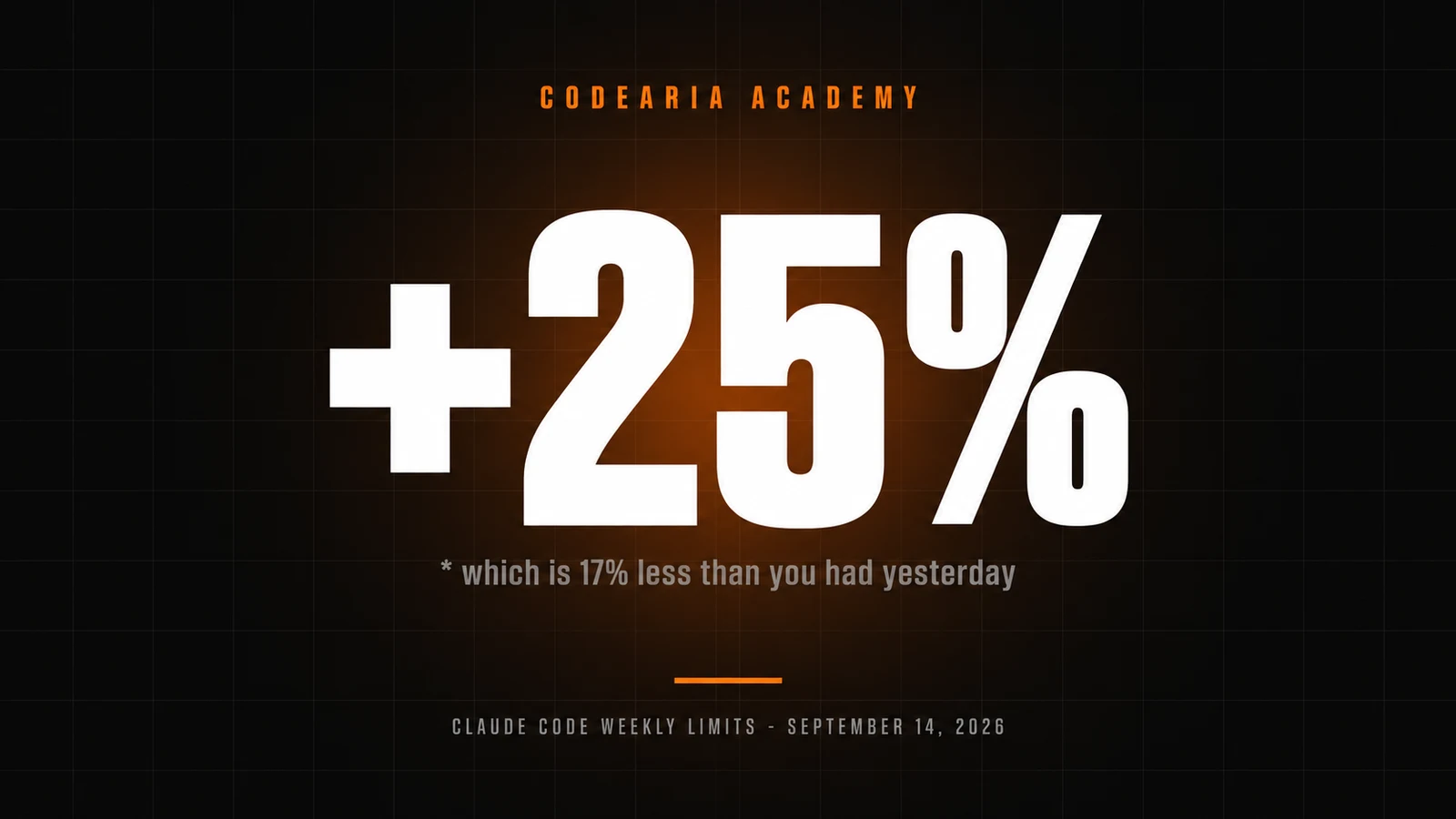 Anthropic raised Claude Code's weekly limits by 25% and cut them by 17% on the same day. How are both numbers true?September 15, 2026
Comments