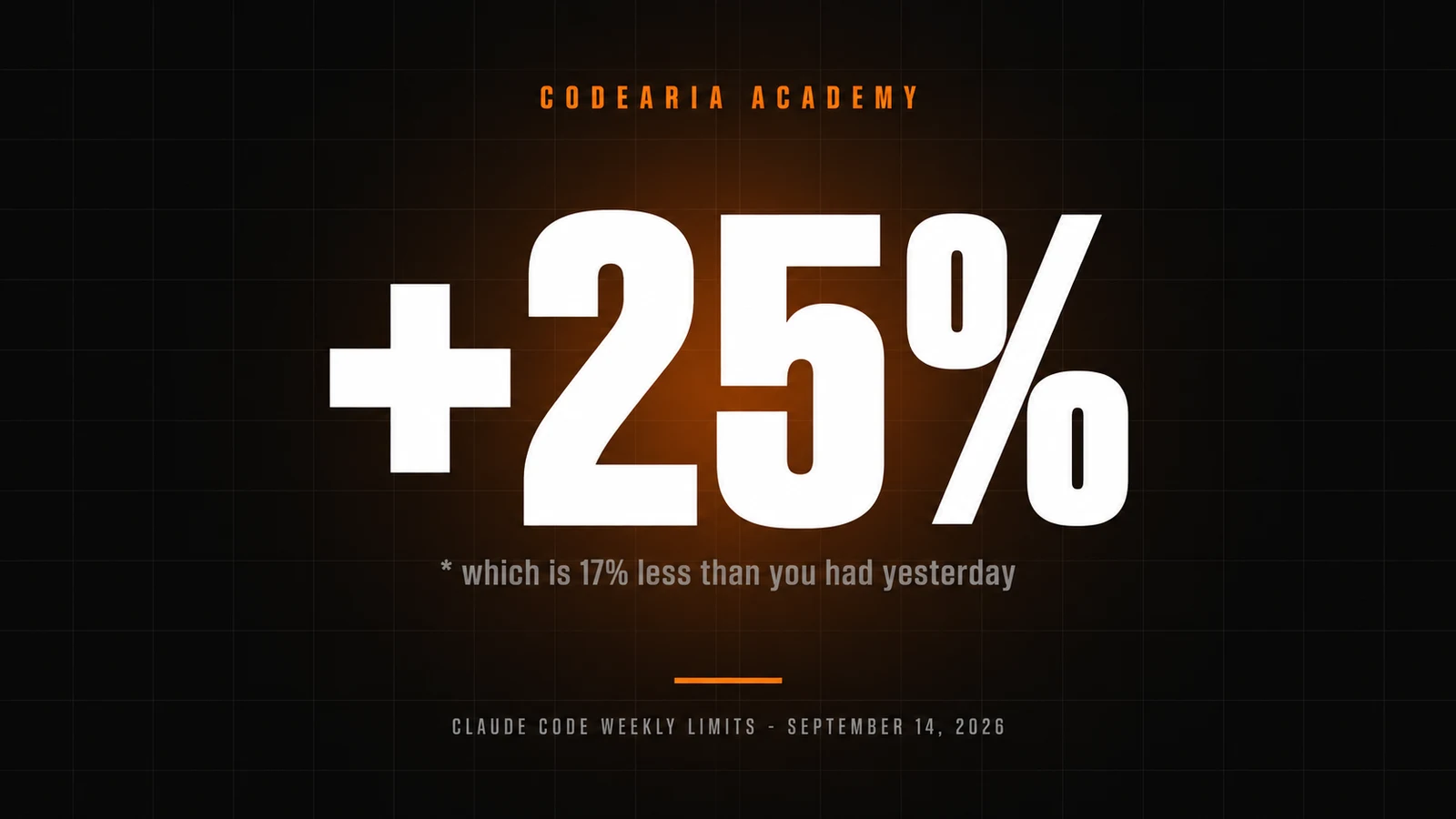
Anthropic raised Claude Code's weekly limits by 25% and cut them by 17% on the same day. How are both numbers true?
Imagine being told you got a raise, then hitting the ceiling earlier than usual the following week. That is what happened to Claude Code on 14 September. Here is why both figures are honest, what actually changed, what did not, and where your weekly allowance really goes.
In this article6
On 29 August 2026 Anthropic announced that from 14 September it would permanently raise standard weekly limits in Claude Code by 25% for Pro, Max, Team and seat-based Enterprise plans. After pushback the company deleted the post and reposted it with a clarification: compared to current levels this works out to a 17% reduction. Both figures are correct because they are measured from different baselines. A temporary 50% boost had been running since 13 May and ended on 13 September. As an index the path reads 100 before the promotion, 150 during it, 125 from 14 September. Five-hour windows, pricing and the other Claude surfaces are unchanged, and Free and consumption-based Enterprise seats are untouched. Anthropic publishes no token figures behind the weekly limits, so they cannot be converted into hours of work. The practical takeaway: read the breakdown in /usage, which shows the share taken by skills, subagents and each MCP server, and remember that agent teams burn roughly seven times the tokens of an ordinary session.
If Claude Code hit its weekly limit earlier than usual this week, it is not you and your tasks did not get heavier. The ceiling itself moved on 14 September.
It started on 29 August. Anthropic posted on X that from 14 September it was permanently raising standard weekly limits in Claude Code by 25%. That read like good news.
A few hours later the post disappeared and came back, now carrying a line about a 17% reduction.
Two numbers, both honest
The trick is what you measure against.
Since 13 May, Claude Code had been running a temporary boost: weekly limits raised 50% above the baseline. It ran through 13 September. The new permanent level sits 25% above that baseline, and below what everyone had grown used to over four months.
| Period | Level (index) | What it means |
|---|---|---|
| Before 13 May 2026 | 100 | The baseline, and the reference point for the +25% figure |
| 13 May to 13 September | 150 | Temporary +50% boost, the reference point for the −17% figure |
| From 14 September 2026 | 125 | The new permanent level |
The arithmetic is plain. 125 against 100 is a quarter up. 125 against 150 is 16.7% down, which Anthropic rounded to 17%. There is no contradiction, only two baselines and a choice about which one to lead with.
Compared to today, this works out to a 17% reduction in weekly limits on Claude Code.
What is telling is not the change itself but that this second sentence was missing from the first version of the post. It appeared after readers did the arithmetic themselves.
What stayed the same
The change is narrow, and that is worth saying out loud, because a fair amount of noise has grown around it:
- Five-hour rolling windows were left alone. If you hit limits within a day, nothing changed for you
- Other Claude surfaces are untouched: web, desktop, mobile and Cowork work as before
- Pricing and plan tiers are unchanged
- Free and consumption-based Enterprise sit outside this. It covers Pro, Max, Team and seat-based Enterprise
How many hours is that
Nobody knows, and that is the honest answer.
Anthropic does not publish how many tokens sit behind a weekly limit, before the change or after. In the company's own words, the weekly allowance does not translate into a fixed number of prompts: too much depends on conversation length, the model you pick and how many tools get called along the way.
We took no measurements of our own before and after 14 September, so we are not offering a figure either. Any "so many hours a week" you read elsewhere is somebody's estimate on their own work, not a vendor figure. On your work it will be different.
Where the weekly allowance actually goes
This is the useful part, more useful than the news itself. With a lower ceiling it pays to know what reaches it first.
On paid plans /usage shows more than bars. It shows a breakdown:
Attribution: share taken by skills, subagents, plugins and each MCP serverBehavior flags: long context and cache misses, flagged at 10% or more eachLoops: scheduled tasks, how often they fire, tokens per run and in totald: last 24 hours, w: last 7 days
Those numbers are approximate and computed from local session history on this machine, so work from another laptop or from claude.ai will not appear. As a pointer it is enough.
From Anthropic's documentation, here is what drains the allowance fastest.
Agent teams. The largest line item, and the one people rarely think about.
The reason is simple: every teammate is a separate Claude Code instance with its own context window, and it keeps spending tokens until it exits.
Long context. Claude Code sends the whole conversation with every request. A one-line question in a session that has been open since morning drags the entire day along with it. Caching makes that cheaper, not free.
Cache misses. Your first message after a break longer than the cache lifetime reprocesses the full context. On a subscription the cache lives an hour; once you are drawing on usage credits, five minutes.
Scheduled tasks. They fire on their interval even while you do nothing, sending your full context each time.
Compaction. /compact reads what it summarises, so on a large context it is an expensive call in its own right. When you do not need continuity, /clear costs nothing.
What to do under the new ceiling
- 1
Read the breakdown instead of guessing
Open /usage, press w, and find what takes the biggest share. Often it is one forgotten MCP server, or a loop you switched on last week and stopped noticing.
- 2
Clear between tasks
/clear when you move to unrelated work. Stale context spends tokens on every message that follows and gives nothing back.
- 3
Do not leave Opus as the default
Sonnet covers most coding work. Keep Opus for architecture and multi-step reasoning, and switch with /model.
- 4
Move instructions out of CLAUDE.md into skills
CLAUDE.md loads at session start and sits in context even while you work on something else. A skill loads only when invoked. The documentation's rule of thumb: keep CLAUDE.md under 200 lines.
- 5
Prefer a CLI over MCP where you have the choice
gh, aws and gcloud are lighter on context: they carry no list of tool definitions that takes up room simply by being connected.
- 6
Hand noisy operations to subagents
Test runs and log parsing leave all that output in the subagent's context, and only the summary comes back to the main conversation.
One more thing that saves nerves: the limit messages differ and are worth telling apart. "You've hit your weekly limit" is the plan window, shared across all models, and switching with /model will not help. "You've hit your Opus limit" is model-specific, and moving to another family gets you working again. A context or auto-compact warning is not a limit at all.
On version 2.1.234 and later, Claude Code can wait for the reset and resume the interrupted task by itself, which is controlled by autoContinueAtUsageLimit.
What this means for you
If you are on Pro or Max and had room to spare, you will notice nothing. If you have been living at the edge these past months, the edge moved down by 17%, and you will meet it on Thursday rather than Monday.
What we find more useful sits elsewhere. The /usage breakdown is not new, but most people open it for the first time when they hit the ceiling. It is worth looking sooner: more often than not one forgotten thing takes a disproportionate share, and removing it is cheaper than changing plans.
Versions and figures here are as of 15 September 2026. Plans and limits change, so check current values in the documentation.
Sources4expand
- https://code.claude.com/docs/en/costs
- https://www.bleepingcomputer.com/news/artificial-intelligence/anthropic-is-cutting-claude-codes-current-weekly-limits-by-17-percent/
- https://www.digitalapplied.com/blog/claude-code-weekly-limit-reduction-september-14
- https://www.notebookcheck.net/Anthropic-announces-a-25-increase-to-Claude-Code-limits-but-there-s-a-17-catch.1382735.0.html
Comments